
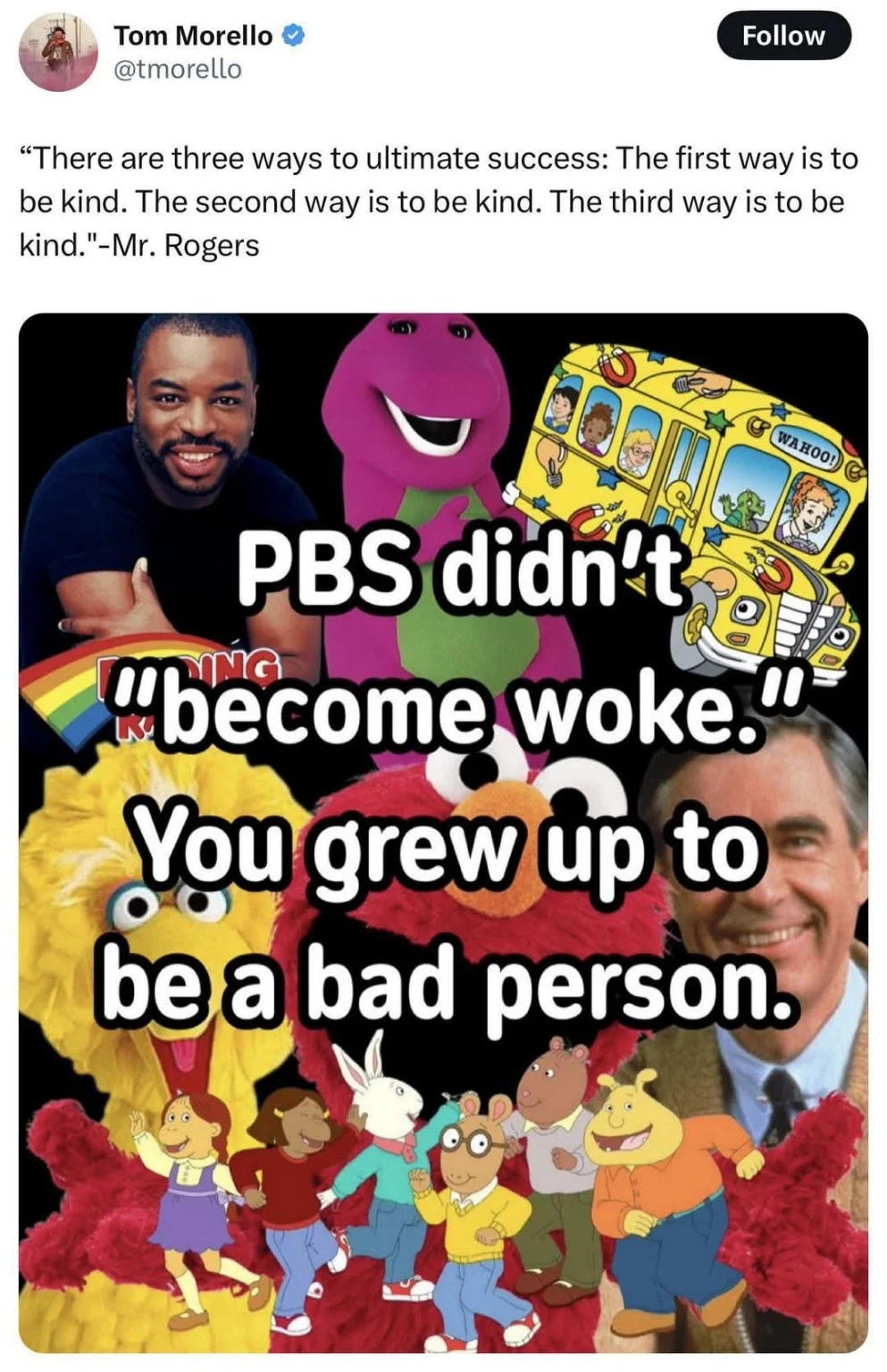
There’s a meme floating around with the familiar faces of Elmo, Big Bird, Mr. Rogers, and the gang from Arthur, stamped with a powerful message: “PBS didn’t ‘become woke.’ You grew up to be a bad person.”
It’s a gut punch, sure—but it’s also a necessary truth.
Public Broadcasting Service (PBS) has always stood for something: kindness, curiosity, empathy, diversity, and community. From Reading Rainbow to Mister Rogers’ Neighborhood, the values woven into the programming weren’t political—they were human. LeVar Burton told us we could be anything if we read. Barney encouraged us to love one another. Ms. Frizzle pushed us to ask questions and explore without fear. And Mr. Rogers? He gently insisted that every child is special, just the way they are.
What changed?
Somewhere along the way, the same messages that once comforted us began to make some uncomfortable. Not because PBS changed, but because we did. We stopped seeing kindness as strength. We stopped teaching empathy as a daily practice. We began to label inclusion as “political,” forgetting that it was always the baseline of decent humanity.
PBS didn’t “go woke.” It stayed rooted in the radical idea that all people deserve dignity, love, and representation. If that now sounds controversial to you, maybe the issue isn’t the programming—it’s your perspective.
Mr. Rogers once said, “There are three ways to ultimate success: The first way is to be kind. The second way is to be kind. The third way is to be kind.” That was never up for debate. That wasn’t a partisan message. That was the call to action for a generation of kids. And for many of us, it still is.
If you find yourself scorning the messages you once embraced as a child, maybe it’s time to sit down, turn on some PBS Kids, and remember who you were before the world told you to harden your heart.
Because Big Bird didn’t change. You did.
And it’s never too late to change back.


