
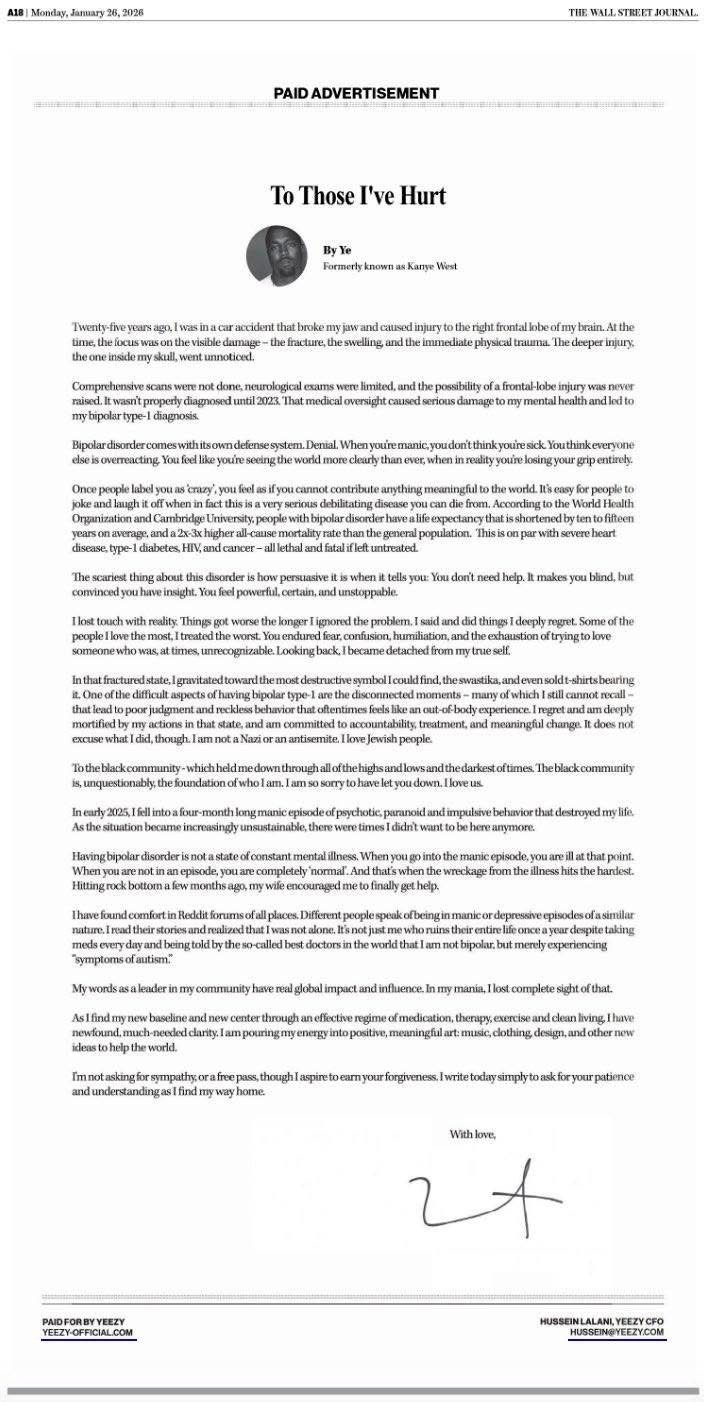
There is something arresting about seeing a full-page paid advertisement in a major newspaper that reads like a personal confession. The piece circulated this week, written by Kanye West, is an open letter of apology, explanation, and appeal. It speaks of trauma, bipolar disorder, public harm, and a desire for forgiveness. It is vulnerable, calculated, and culturally significant. It forces us to confront a question many would rather avoid. What does accountability look like when mental illness, celebrity, and harm intersect.

West frames much of his history through a medical narrative. He describes a traumatic brain injury, delayed diagnosis, and later identification of bipolar disorder as foundational to years of erratic behavior. His description of manic episodes aligns with established clinical definitions. The National Institute of Mental Health notes that manic states can involve impulsivity, grandiosity, reduced need for sleep, and impaired judgment leading to risky or harmful behavior. This context matters, and it is medically legitimate.
But explanation is not exoneration.
The letter acknowledges damage to loved ones, collaborators, and broader communities. It references his public embrace of extremist symbolism and rhetoric, acts that extended far beyond private suffering. When a global cultural figure amplifies hate, the harm is not contained. It reinforces dangerous narratives, emboldens harmful ideologies, and leaves communities carrying consequences long after headlines fade.
West states that he is not seeking a free pass. Still, the structure of the message leans heavily on illness as framing. This is a delicate line. Mental illness can explain behavior. It cannot excuse harm. Both realities must coexist if accountability is to be meaningful. Trauma-informed practice teaches us to ask what happened to a person. Justice-informed practice asks what that person did, who was harmed, and what repair is required.
The letter describes entering treatment, medication, therapy, exercise, and healthier living. These are important and necessary steps. Yet recovery that remains purely internal is incomplete when harm has been public. Repair requires outward-facing action. Specific acknowledgment of wrongdoing. Willingness to listen to harmed communities without controlling the terms of forgiveness. Concrete behavioral change sustained over time. Acceptance that trust may not return quickly, or at all, without consistent evidence.
In restorative justice models, apology is only the invitation to a longer process. Repair is built through action, not performance. Forgiveness is never owed, and cannot be demanded on a schedule.
There is also a broader cultural lesson here. Society still struggles to hold space for mental illness without either romanticizing it or weaponizing it as defense. We need frameworks where people can disclose illness without using it as a shield, and where seeking treatment is not treated as public relations but as long-term personal labor.
For those working in trauma-informed leadership, education, or community advocacy, this moment is instructive. Healing and accountability are not opposites. They are parallel obligations. One without the other collapses.
West closes by asking for patience and understanding as he finds his way forward. Patience may be reasonable. Understanding may be possible. But trust, once broken at scale, is rebuilt only through consistent action, not explanation.
This letter is not the end of the story. It is the opening test of whether words will be followed by sustained change. And in a culture that too often confuses confession with transformation, that distinction matters.


