There are films that entertain, and there are films that matter. And then there are the rare few—like My Dead Friend Zoe—that manage to do both, sometimes in the same breath.
Director and co-writer Kyle Hausmann-Stokes takes what, on paper, sounds like a tonal misfire waiting to happen—a buddy comedy about PTSD—and threads the impossible needle between grief and humor, heartache and hilarity. What emerges is not just a clever or “different” film. My Dead Friend Zoe is a raw, reflective, and often riotously funny testament to what it means to survive war, memory, and the mess of mourning someone who won’t leave you… even in death.
War, Women, and Wounds That Don’t Bleed
The film opens not with tragedy, but with Rihanna.
Two female soldiers—Merit (a magnetic Sonequa Martin-Green) and Zoe (the always compelling Natalie Morales)—blare “Umbrella” from a Humvee in Afghanistan in 2016, more concerned with hitting the beat than ducking enemy fire. It’s a brilliantly misleading intro, one that tells us everything about the tonal tightrope this film is about to walk. And it’s one that only works because Hausmann-Stokes, himself a veteran, knows this world. The way he and co-writer A.J. Bermudez use gallows humor as a coping mechanism feels authentic, earned, and deeply rooted in lived experience.
From there, the movie flashes forward to a therapy session where Merit sits silently. Zoe sits beside her, snarking at the group’s vulnerable confessions—until we blink, and the chair is empty. Zoe is dead. And Merit is the only one who can see her.
This setup, echoing the ghostly companions of Ghost or Fight Club, could’ve veered into gimmick. But Morales doesn’t play Zoe as a wistful apparition. She’s biting, irreverent, and very much alive in spirit. She’s also the embodiment of Merit’s unprocessed trauma—her best friend, her war buddy, her unresolved guilt, her survivor’s burden. Zoe is both balm and blade, both the comfort and the reason Merit cannot move forward.
Sonequa Martin-Green: A Star Solidified
Martin-Green is no stranger to complex roles—The Walking Dead and Star Trek: Discovery gave her a long runway to build a sci-fi fan base—but this film demands something different. It’s an internal performance, restrained but devastating. As Merit, she plays emotional suppression like a symphony. It’s the kind of performance that critics remember at year’s end.
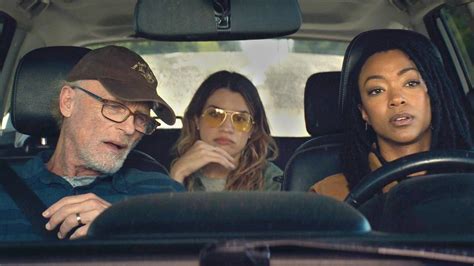
Merit’s arc is not just about healing—it’s about permission. Permission to feel. Permission to falter. Permission to grieve on her own terms. Whether she’s trading sarcastic barbs with Zoe, struggling to engage in group therapy with Morgan Freeman’s no-nonsense counselor, or sitting lakeside with her Alzheimer’s-stricken grandfather Dale (played with fierce tenderness by Ed Harris), Martin-Green holds the screen with a presence that’s physical, emotional, and completely commanding.
More Than a Ghost Story—A Mirror for Veterans
Zoe isn’t just a hallucination or literary device—she’s the representation of thousands of real stories that never got closure. Hausmann-Stokes dedicates the film to two of his fallen platoon mates who died by suicide, and that dedication is felt in every frame. This isn’t trauma-porn. It’s a love story—between friends, between veterans, and between the living and the dead.
Morgan Freeman adds gravitas in a role that could’ve easily been perfunctory. As the counselor running the veteran support group, he does more with a single raised eyebrow than most actors do with a monologue. He doesn’t let Merit coast, even when Zoe’s ghost mocks the kumbaya vibes of the therapy room. It’s a powerful reminder that confronting trauma isn’t linear—it’s jagged, often uncomfortable, and frequently resisted by those who need it most.
Meanwhile, Ed Harris’s Dale offers a haunting portrait of the “old guard”—a Vietnam vet losing his grip on memory but still clutching fiercely to his dignity. There’s a brilliant scene where Dale and Merit compare their wartime scars—not with bitterness, but with quiet camaraderie. It’s one of the film’s emotional peaks.
Tonally Risky, But Earned Through Truth
Yes, the film toggles through tones—sometimes dizzyingly so. There are shifts that may jar some viewers, especially as the ghost story dances on the edge of psychological horror, particularly in moments where Zoe’s presence becomes more suffocating than comforting. And yet, it works.
Because in real life, trauma doesn’t arrive in neat genres. One moment you’re laughing at a dumb memory; the next, you’re drowning in it. My Dead Friend Zoe understands that balance better than most.
Editor Ali Greer deserves praise here for navigating the film’s flashbacks, fantasy elements, and emotional layers with a confident hand. The pacing never drags, and the film’s tight 101-minute runtime ensures it doesn’t overstay its welcome—or its emotional resonance.
Final Verdict: A Film That Will Haunt You—in All the Right Ways
My Dead Friend Zoe is not just a film about veterans. It’s a film about humans—hurting, healing, and sometimes haunted by both their memories and their love.
It’s a film about friendship that outlives death. About grief that doesn’t follow rules. About the kind of laughter that comes from pain, not in spite of it.
Kyle Hausmann-Stokes has crafted a daring and compassionate debut, one that uses humor not as a deflection but as an invitation—to remember, to reconnect, to understand. And in an industry that too often sidesteps the stories of women soldiers and the nuanced realities of PTSD, this film is a welcome, necessary addition.
A Groundbreaking Partnership
One of the most remarkable—and perhaps most underappreciated—elements of My Dead Friend Zoe is its backing by Legion M, the world’s first fan-owned entertainment company. In an industry dominated by legacy studios, billionaire producers, and algorithmic content decisions, Zoe stands as a quiet revolution: a film made with, by, and for the people.
Legion M isn’t just a quirky funding model or gimmick. It’s a radical rethinking of how movies get made—and more importantly, who gets to decide which stories are worth telling. With My Dead Friend Zoe, Legion M didn’t just write checks—they gave this deeply personal, risky, emotionally complex story a platform in a system that too often sidelines tales about mental health, grief, veterans, and female soldiers.
It’s hard to imagine a traditional studio greenlighting a film like this. A buddy dramedy about a dead best friend with PTSD, told through the lens of two women veterans, featuring flashbacks, hallucinations, and gut-wrenching emotional shifts? That’s not exactly box office catnip by Hollywood’s usual standards. But Legion M doesn’t operate on fear or formula—they invest in stories that connect.
This partnership also signals something bigger: a new era of storytelling, where niche becomes necessary and audiences become stakeholders. The people who helped fund Zoe weren’t just passive consumers—they were believers, ambassadors, part of the movement to get this film in front of screens when so many forces might’ve kept it buried.
And let’s be honest: there’s something poetic about a story so rooted in communal healing and friendship being brought to life through community itself.
With My Dead Friend Zoe, Legion M proves that powerful films don’t need to beg for relevance. They just need the right people to believe in them. This is more than a film—it’s proof of what happens when we let empathy, not ego, lead production.


