
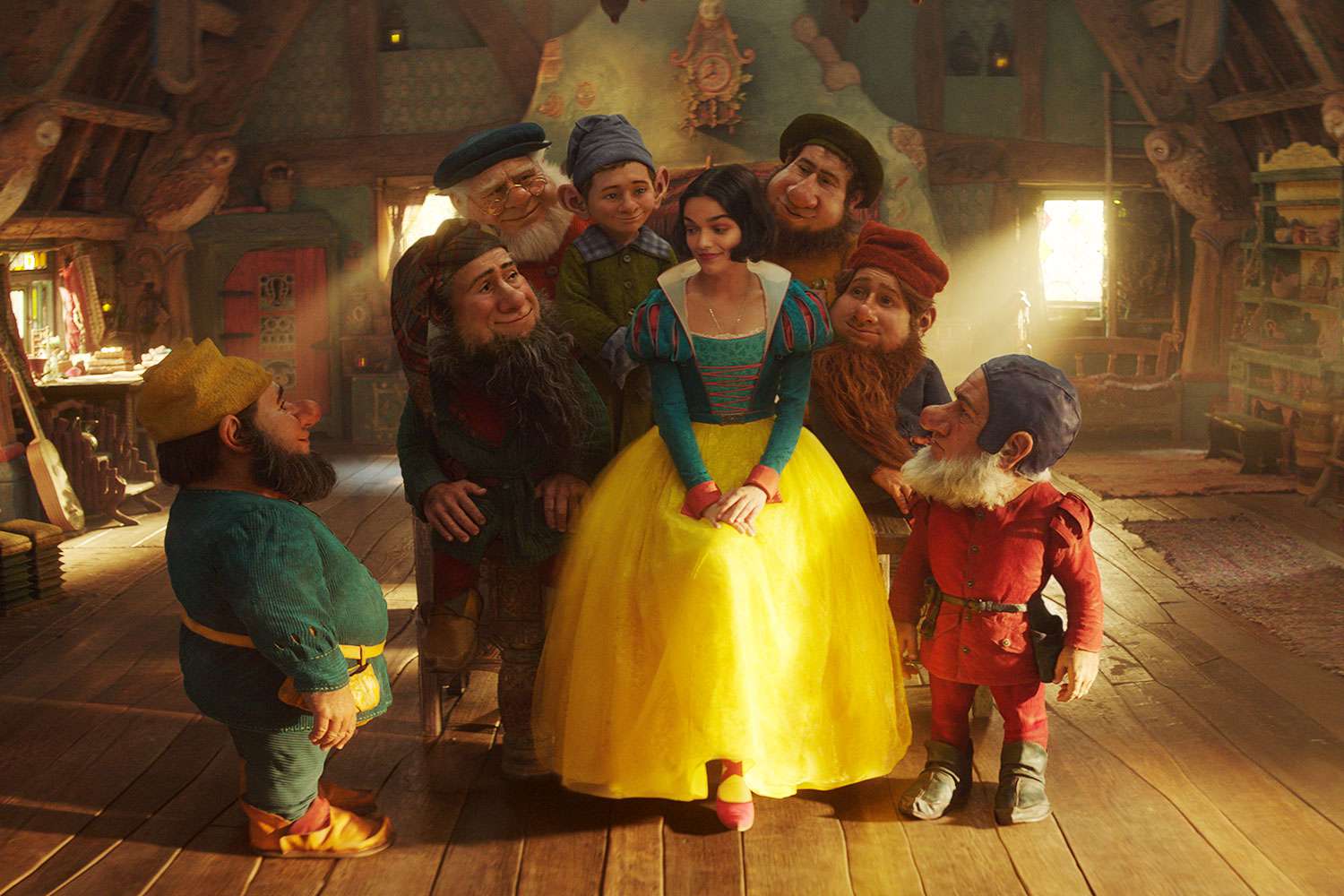
To be fair—and fair is a word both heavily repeated and deeply problematized in this remake—Marc Webb’s 2025 Snow White is a film that, like its title character, is trying desperately to outrun something. But unlike the fleeing princess clawing through thorny trees, this film isn’t just running from a huntsman. It’s running from history, from scrutiny, from nostalgia, and ultimately, from itself.
Tackling Disney’s foundational property, the one that built the literal Burbank lot, is no small feat. The original Snow White and the Seven Dwarfs (1937) wasn’t just a hit—it was a technological marvel, a cultural touchstone, and a commercial triumph. Revisiting it nearly a century later, in an era that simultaneously demands justice and resents change, was always going to be fraught. But rather than rise boldly to that challenge, this Snow White tiptoes across a tightrope of modern sensibilities and legacy obligations—and frequently wobbles off.
An Uneven Apple: The Story’s New Ingredients
Erin Cressida Wilson’s screenplay attempts to subvert and deepen the familiar tale, and in doing so, it gestures at meaningful ideas. Here, “fair” isn’t just about beauty—it’s about justice. Snow White, as a child (played by Emilia Faucher), is told to be “fearless, brave, true, and fair.” Her silver necklace literally spells it out, as though the filmmakers don’t trust the audience to internalize subtext.
Rachel Zegler’s Snow White is no damsel dreaming of rescue. She’s a monarch-in-the-making, stripped of her inheritance and spirit by Gal Gadot’s Evil Queen, who is still obsessed with vanity and power but now also oddly tethered to the theme of legacy. The romance subplot trades Prince Charming for Jonathan (Andrew Burnap), a roguish, charismatic Robin Hood-type who feels refreshingly human in an otherwise emotionally distant film.
But for all its good intentions, Snow White never quite figures out what it wants to be—a revisionist feminist epic or a faithful re-skin of a beloved cartoon. It ends up splitting the difference, which in storytelling terms, means it satisfies no one.
The Fairest of Them All? Not Quite
The film’s most compelling choice—casting Rachel Zegler—was met with predictable, racially coded backlash. Disney smartly reframes the name “Snow White” not as a nod to skin tone, but to the snowstorm during which the character was born. Zegler, a charming and capable performer, brings sensitivity and vocal prowess to the role. When she sings, the film lifts. Unfortunately, these moments are too few.
The real letdown, however, is Gal Gadot’s Evil Queen. Despite the metallic rustle of Sandy Powell’s fabulous costumes and plenty of screen time, Gadot seems miscast—her performance icy, but never iconic. Her solo number, “All is Fair,” is limp, both lyrically and vocally, falling miles short of the delicious villainy Disney once gave us in “Poor Unfortunate Souls” or “Be Prepared.” She is regal, yes—but she is not scary, funny, or unforgettable.
The new songs by Benj Pasek and Justin Paul (La La Land, The Greatest Showman) are mostly forgettable. “Princess Problems,” a Snow White–Jonathan duet, is the strongest of the bunch, but even that feels more like a Broadway B-side than a Disney classic in the making. The film’s musical palette is underwhelming, especially given the power of the original’s “Someday My Prince Will Come,” which is conspicuously absent here.
A Legacy Too Large to Reimagine
Every moment of this film feels like it’s dragging the weight of legacy behind it. There’s a sense of obligation to reference iconic images and melodies (we do get “Hi-Ho” and bits of “Whistle While You Work”), but the updates are cosmetic. The joy, the whimsy, the sheer innovation of the original is gone. Replaced instead by CGI characters that land squarely in the uncanny valley—most notably the dwarfs.
In an effort to sidestep the problematic depiction of little people, Disney opts for CGI representations that lack charm, specificity, or emotional resonance. They’re not magical. They’re not memorable. And their inclusion only furthers the disjointed feel of the film—torn between wanting to erase the past and being chained to it. One “woodsman” of shorter stature (played by George Appleby) is awkwardly inserted, a half-measure nod to the discourse, which feels less like inclusion and more like damage control.
Dopey, still mute, is reimagined with a “gentle, childlike” aura that plays dangerously close to ableist tropes. The film gestures at emotional depth for him—but never lands it. The mining subplot (still present, inexplicably) serves no clear purpose and pulls attention from Snow White’s arc rather than enhancing it.
From Magic to Mishmash
Director Marc Webb (The Amazing Spider-Man, 500 Days of Summer) is no stranger to emotion and spectacle, but here, he seems caught between studio mandates and narrative ambition. The result is an occasionally beautiful but often empty film. Lush forests and elegant sets can’t compensate for a story that doesn’t know if it’s for kids, adults, or critics.
The most damning thing a Disney film can be is forgettable. And Snow White (2025) teeters dangerously close to that fate.
There are moments of spirit. Rachel Zegler deserves better. The reframing of leadership as “fairness” has potential. But the film is too caught up in cleaning up history to craft something visionary. It scrubs. It edits. It recalibrates. But it never enchants.
Final Verdict: Just, Well… Fair
In the grand hierarchy of Disney’s live-action remakes, Snow White (2025) ranks somewhere between the misguided grit of Mulan (2020) and the hollow spectacle of The Lion King (2019). It tries harder than either, but trying isn’t the same as transcending.
The fairest of them all? Not this time.


