
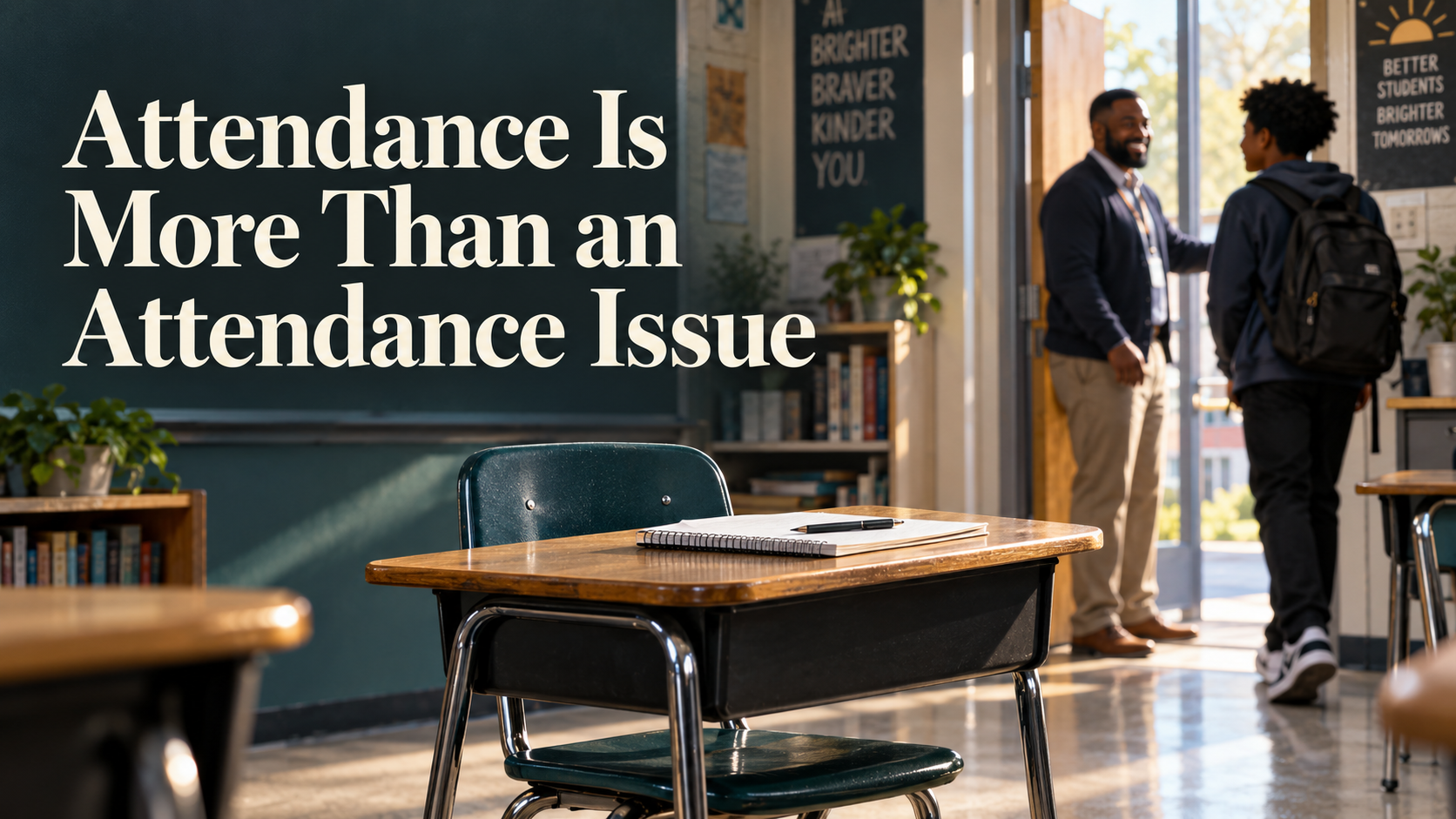
An empty desk tells us that a student is missing. It tells us very little about why.
Yet too many conversations about school attendance begin and end with the absence itself. We count missed days, send notices, convene attendance teams, and remind families that school matters. Those actions have a place. But when the response stops there, we risk confusing documentation with intervention.
My concern is that we keep asking students to demonstrate commitment to school without examining whether our systems make that commitment possible. Attendance deserves urgent attention. It also deserves a more honest diagnosis.
Michigan offers a useful starting point. According to the Michigan Department of Education, chronic absenteeism declined from 38.5 percent in 2021–22 to 27.9 percent in 2024–25. That is substantial progress, but it still leaves more than one in four students missing at least 10 percent of school days. Among economically disadvantaged students, the figure was 38.6 percent. Michigan Department of Education, 2025
Those numbers should prompt questions about access and support before they become judgments about character.
We also need to be precise about what we are counting. Michigan’s attendance reporting includes both excused and unexcused absences and explicitly distinguishes its data from truancy rates. A student missing instruction because of illness and a student avoiding an unsafe school environment may appear in the same chronic absence category. Their needs require different responses. MI School Data, Student Attendance
This distinction matters because an absence category cannot tell us which intervention to choose. A reminder cannot repair a disrupted transportation arrangement. A conference cannot stabilize housing by itself. A warning letter does not explain how a student should manage responsibilities at home that adults have been unable to resolve.
The pandemic intensified these concerns, but it did not create all of them. A January 2024 report from Michigan State University’s Education Policy Innovation Collaborative found that Michigan Partnership schools already faced high chronic absenteeism before COVID-19. Its examination of the 2022–23 school year also documented educators’ concerns about students’ mental health and socioeconomic challenges. These findings concern a particular group of schools, not every Michigan district, but they challenge the idea that reopening buildings would automatically restore attendance. Singer and colleagues, 2024
Reopening a building is an event. Rebuilding a student’s ability to participate in it takes sustained work.
Some of that work must happen inside schools. Students should be able to identify an adult who knows them, notices a change, and follows through. They should have confidence that reporting bullying will lead to action. They should encounter instruction that offers challenge, relevance, and a realistic path to success after falling behind.
National research supports taking connection seriously. A CDC study published in 2023, using 2021 high school survey data, found that students reporting stronger school connectedness were less likely to report missing school because they felt unsafe: 5.9 percent, compared with 11.0 percent among students reporting less connection. This was an association, not proof that a belonging initiative caused better attendance. Still, it gives schools a compelling reason to examine students’ experiences of safety and connection. Wilkins and colleagues, 2023
Consider what happens when a student returns after several missed days. A public comment about finally showing up may communicate frustration, but it offers no help catching up. A private welcome, a manageable plan for missed learning, and a scheduled check-in give that student something useful to do next. I would make that approach a routine expectation, with staff time and support to carry it out.
That is how I believe a trauma-informed approach should function: predictable expectations, respectful inquiry, and a response shaped by the student’s circumstances. It should never require a student to disclose painful experiences simply to receive help. Nor should adults assume that every absence signals trauma. The point is to investigate carefully and respond without humiliation.
School leaders also need to resist the search for a single attendance solution. Detroit PEER, a Wayne State University research center, reported in May 2026 that schools differed in their contributions to attendance even after accounting for student populations and context. Most individual attendance strategies, however, did not strongly distinguish schools with higher and lower estimated contributions. The researchers emphasized coherent implementation and the limits of school-based efforts when structural barriers are substantial. Detroit PEER, 2026 research summary
My reading is that buying another incentive program or assigning another staff member to make calls will accomplish little if the school cannot act on what those calls reveal. Relationships need resources behind them. A trusted adult who repeatedly hears about a barrier but has no way to help remove it is being asked to carry a responsibility without the means to fulfill it.
Michigan has examples of a broader response. In October 2025, MDE highlighted Lawrence Public Schools’ work with business and industry partners on housing opportunities, alongside additional student support and family engagement. Its attendance rate increased from 93.1 to 94.1 percent between 2023–24 and 2024–25. The report does not isolate which actions produced that improvement, but it shows a district treating community conditions as relevant to educational participation. Michigan Department of Education, October 2025
I would like to see schools apply that broader thinking to their everyday routines. Review emerging patterns before a student reaches the chronic absence threshold. Ask students and caregivers what is getting in the way. Assign a person to follow through, document the support offered, and check whether it actually helped. Invite students with attendance difficulties into the conversation about improving school.
Accountability should extend to those adult responsibilities. Alongside the absence rate, leaders should ask how quickly families received a response, whether promised assistance arrived, and whether returning students could successfully rejoin their learning. District and state leaders should examine whether transportation, counseling, and community partnerships have the capacity to meet the needs schools identify.
Families have responsibilities, too. Clear expectations, reliable communication, and daily routines matter. But a serious partnership must leave room for families to explain what is preventing those routines from working. Schools should be places where asking for help leads to a useful response.
Attendance is too important for us to keep treating the record of a problem as its explanation. Every empty desk deserves our attention. The work begins when we ask what must change for the student who belongs there to return, participate, and keep coming back.
Sources and Further Reading
- Michigan Department of Education. (2025, September 17). Michigan school attendance improves for third consecutive year. Statewide attendance trends, chronic absenteeism rates, and disparities affecting economically disadvantaged students.
- MI School Data. (n.d.). Student attendance. Michigan’s official attendance reporting resource, including the distinction between chronic absenteeism and truancy.
- Singer, J., Strunk, K. O., Woulfin, S. L., Cullum, S., Lizarraga, L., Watson, C., & Harbatkin, E. (2024, January). Student attendance and well-being in Round 4 Partnership districts. Education Policy Innovation Collaborative, Michigan State University. Research examining attendance, mental health, and student support in Michigan Partnership districts following pandemic disruptions.
- Wilkins, N. J., Krause, K. H., Verlenden, J. V., et al. (2023). School connectedness and risk behaviors and experiences among high school students—Youth Risk Behavior Survey, United States, 2021. MMWR Supplements, 72(1), 13–21. National research examining associations between school connectedness, student well-being, and missing school because of safety concerns.
- Detroit Partnership for Education Equity & Research. (2026, May 26). Identifying effective attendance strategies in Michigan. Wayne State University. Research summary available through Detroit PEER. Findings on schools’ contributions to attendance, attendance strategies, and the importance of coordinated support.
- Michigan Department of Education. (2025, October 16). Michigan’s K–12 attendance, 2026 state budget discussed at State Board of Education meeting. Includes Lawrence Public Schools’ approach to attendance through housing partnerships, student support, and family engagement.


Leave a Reply
You must be logged in to post a comment.